
Published: April 2025 | Last Updated: April 2025
Author: Golden Life BD Expert Team | Reviewed by: Dr. Mufassir Husain Sohel, Addiction Medicine Practitioner & Psychotherapy Expert, MBBS (BMDC Reg: A-26981), Golden Life Rehabilitation Center
Introduction — When a Parent’s Instinct Says Something Is Wrong
You notice it in small things first. Your son, who used to come home for dinner and talk about his day, now disappears into his room the moment he walks in. Your daughter’s eyes look different — glassy, distant, or sometimes unnaturally bright. The school calls about missed classes. Money goes missing from your wallet. And when you try to ask what is going on, you are met with rage, tears, or a wall of silence that was not there a year ago.
If this sounds familiar, you are not alone — and you are not imagining things. According to the United Nations Office on Drugs and Crime (UNODC), Bangladesh faces a serious and growing drug problem, with young people — particularly those between 15 and 30 years old — making up the largest segment of drug users. Substances like Yaba, marijuana (ganja), phensedyl, and heroin are widely accessible in urban areas including Dhaka, Chittagong, and Sylhet. The problem does not discriminate by family income, neighbourhood, or education level.
The hardest part for most parents is not the anger or the fear — it is the uncertainty. Is this just teenage behaviour? Or is something more serious happening? This guide is written specifically to answer that question. We will walk you through the physical, behavioural, and emotional signs of drug addiction in children and teenagers, explain why young people in Bangladesh are particularly vulnerable, and — most importantly — tell you clearly what your next steps should be if your fears turn out to be justified.
At Golden Life Rehabilitation Center, we have been working with families in exactly this situation since 2004 — over 22 years of helping parents navigate one of the most difficult experiences a family can face. This article draws directly on that experience. Read it carefully. Share it with your spouse or co-parent. And know that whatever you find, there is a path forward.
What Is Drug Addiction in Young People?
Drug addiction — clinically referred to as Substance Use Disorder (SUD) — is not simply a bad habit or a phase that young people grow out of on their own. It is a complex condition in which a person becomes physically and psychologically dependent on a substance to the point where stopping causes intense discomfort, and continuing causes progressive harm to their health, relationships, and life functioning.
Young people’s brains are still developing — particularly the prefrontal cortex, which governs decision-making, impulse control, and the assessment of consequences. This makes teenagers and young adults significantly more vulnerable to addiction than older adults. The World Health Organization (WHO) recognises that early-onset drug use — beginning in adolescence — carries a substantially higher risk of developing severe, long-term dependency compared to use that begins in adulthood.
In the Bangladeshi context, the most commonly used substances among young people include Yaba (a methamphetamine-caffeine tablet), ganja (marijuana), phensedyl (a codeine-based cough syrup misused as a recreational drug), heroin, and increasingly, prescription sleeping pills and sedatives. Each substance produces different signs and symptoms — but all share a common pattern: escalating use, increasing secrecy, and progressive withdrawal from family and responsibilities.
Addiction affects the entire family — not just the person using. Parents, siblings, and extended family members all experience stress, guilt, confusion, and grief. Recognising the signs early and responding with the right support — rather than punishment alone — is what determines whether a young person gets the help they need before the situation becomes a crisis.
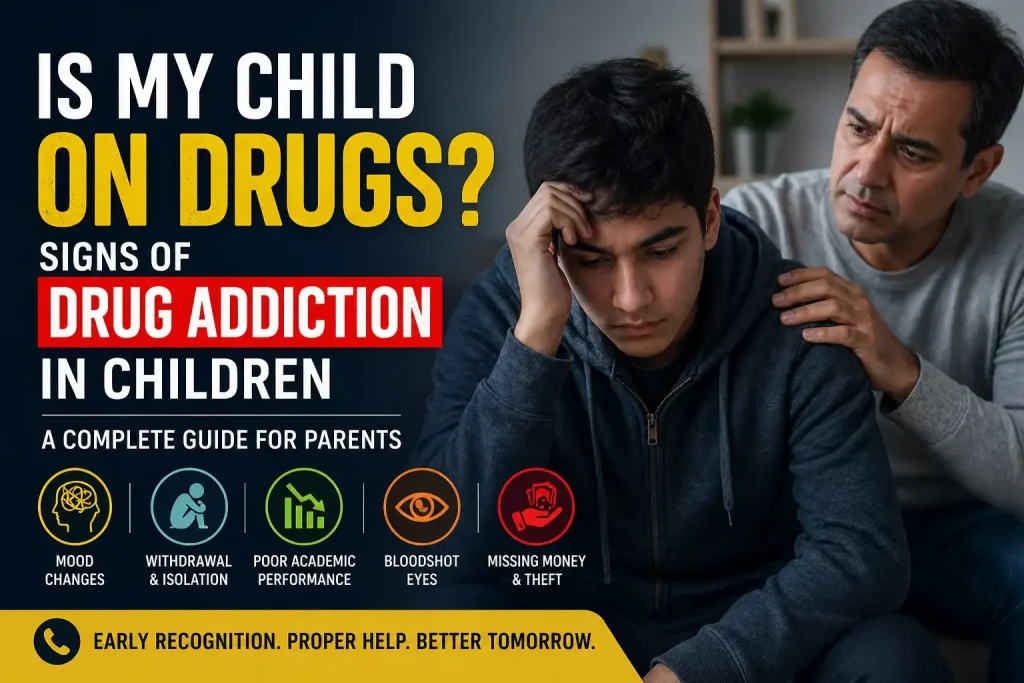
12 Warning Signs Your Child May Be Using Drugs
No single sign on this list is definitive proof of drug use on its own. However, if you are observing several of these signs together, consistently, over a period of weeks — that warrants serious attention and a professional assessment.
1. Sudden and Unexplained Changes in Mood
Rapid mood swings — euphoria followed by irritability, rage followed by unusual calm — are among the earliest and most consistent signs of substance use. If your child’s emotional state seems to follow no predictable pattern and has changed markedly from their normal personality, take notice. With Yaba use in particular, periods of intense energy and talkativeness are followed by crashes involving extreme tiredness and aggression.
2. Withdrawal from Family and Friends
A young person who was previously social and communicative begins spending hours locked in their room, stops joining family meals, avoids conversation, and loses interest in friends they have had for years. They may simultaneously begin spending time with a new group of people their family does not know and is not permitted to meet.
3. Declining Academic or Professional Performance
Teachers report missed classes, incomplete assignments, or falling grades. An employed young person begins arriving late, missing shifts, or losing jobs. The child who was previously motivated and goal-oriented seems to have lost all ambition. This is one of the most consistent early indicators families report when looking back on when the problem started.
4. Bloodshot or Glazed Eyes
Persistent red, watery, or glassy eyes — especially without any apparent illness or allergy — are a physical sign associated with marijuana use, alcohol, and certain sedatives. Pinpoint pupils (very small) can indicate opiate or heroin use; dilated pupils (very large) can suggest stimulant use such as Yaba.
5. Unexplained Financial Requests or Missing Money
Drug use is expensive, and young people without their own income will find ways to fund it. Repeated requests for money with vague explanations, money disappearing from wallets or shared spaces, or the selling of personal belongings are serious warning signs. In some cases, families also notice valuables — jewellery, electronics — going missing.
6. Changes in Sleep Patterns
Sleeping through the day and being awake all night, or going days with very little apparent sleep, are common with stimulant use (Yaba, cocaine derivatives). Alternatively, sleeping excessively and being nearly impossible to rouse can indicate opioid, sedative, or alcohol use. Either extreme — especially when it is a clear departure from their usual pattern — is worth noting.
7. Neglect of Personal Hygiene and Appearance
A young person who previously cared about how they looked — their clothes, hair, personal cleanliness — begins to stop caring entirely. This is not merely teenage untidiness; it is a significant, noticeable deterioration in basic self-care that family members often describe as “they don’t seem to care about themselves anymore.”
8. Secretive Behaviour and Unexplained Absences
Going out without explanation, refusing to say where they have been, locking their room, password-protecting devices and becoming agitated when asked about them, speaking in hushed tones on the phone — secretiveness that goes well beyond normal teenage privacy is a red flag. Trust your instinct: most parents know the difference between a child protecting their privacy and a child hiding something serious.
9. Changes in Appetite and Weight
Stimulant drugs like Yaba dramatically suppress appetite, leading to rapid and unexplained weight loss. Cannabis (ganja) tends to increase appetite but may still disrupt normal eating patterns. Significant changes in body weight — in either direction — without a medical explanation deserve attention.
10. Physical Symptoms: Tremors, Sweating, Nosebleeds
Depending on the substance, you may notice physical signs including: trembling hands, excessive sweating unrelated to heat or exercise, frequent nosebleeds (associated with snorting substances), track marks or unexplained bruising on arms (associated with injection drug use), or persistent coughing. Any of these, without a clear medical cause, should prompt immediate professional evaluation.
11. Unusual Smells on Breath, Clothing, or in Their Room
The smell of alcohol, marijuana, or tobacco on a young person’s breath or clothing is an obvious sign. Less obvious is the smell of chemical solvents or burning — sometimes associated with certain inhalants or drug paraphernalia. Finding rolling papers, foil, syringes, small plastic bags, or unfamiliar pills in their belongings or room is direct physical evidence of drug use.
12. Paranoia, Hallucinations, or Extreme Anxiety
Severe mental health symptoms — believing they are being watched or followed, hearing or seeing things that are not there, experiencing episodes of intense, groundless panic — can be caused directly by drug use, particularly Yaba, which is known to trigger psychosis with prolonged use. These symptoms require immediate professional intervention — both psychiatric and addiction-focused.
Why It Happens — Risk Factors in the Bangladeshi Context
Peer Pressure and Social Circles
The single most commonly reported entry point into drug use among young Bangladeshis is peer pressure — friends who use, normalise it, and make it feel like a social requirement. Young people who are eager to belong, who are new to a college environment, or who have recently moved to Dhaka from smaller towns are particularly vulnerable during transition periods.
Academic and Family Pressure
Bangladesh’s intensely competitive academic culture — HSC exams, university admission tests, job market competition — creates high levels of stress and anxiety in young people. Some turn to substances initially as a perceived coping mechanism, particularly stimulants like Yaba, which are sometimes falsely marketed among students as “concentration aids.”
Easy Availability of Substances in Urban Areas
Yaba, ganja, and phensedyl are widely and relatively cheaply available in many urban neighbourhoods. The Department of Narcotics Control (DNC) Bangladesh has reported consistent challenges in controlling street-level distribution. Proximity and affordability dramatically lower the barrier to first use.
Mental Health Conditions Going Unaddressed
Depression, anxiety, and trauma are frequently undiagnosed and untreated in young Bangladeshis — partly due to stigma around mental health, and partly due to limited accessible mental health services. Young people experiencing these conditions may self-medicate with substances, leading to co-occurring addiction and mental health disorders that require integrated treatment. Our clinical team at Golden Life BD includes both addiction medicine and psychiatric expertise precisely for this reason.
Family Conflict and Absent Parental Connection
Young people who feel emotionally disconnected from their parents — whether due to parental conflict, frequent absences, or an atmosphere where problems cannot be spoken about openly — are at significantly higher risk. A strong, trusting parent-child relationship is one of the most protective factors against drug use. This does not mean perfect parenting; it means a child who believes they can come to you with a problem.
What to Do If You Suspect Your Child Is Addicted — Step by Step
- Stay calm and do not confront in anger.
Your first instinct may be to confront your child immediately — loudly, emotionally, and with punishment. In almost every case, this approach closes the door on communication and drives the problem further underground. Take time to collect yourself, speak with your spouse or a trusted person, and approach the situation with as much calm as you can manage. This is not weakness — it is strategy. - Observe and document what you are seeing.
Before any conversation, spend a few days noting specific observations: what you saw, when, and how often. Specific, factual observations (“I noticed you came home at 3am three times this week and your eyes were red”) are far more effective in a difficult conversation than general accusations (“You are always like this”). Documentation also helps a professional make a faster and more accurate assessment. - Choose the right moment for an honest conversation.
Find a quiet, private time when your child is not visibly intoxicated, and when neither of you is already in an argument about something else. Express concern from a place of love rather than blame: “I have noticed some things that are worrying me, and I love you too much to ignore them.” DO listen as much as you speak. Your child may be more ready to talk than you expect — or they may shut down entirely. Either way, the conversation needs to happen. - Seek professional assessment immediately.
Do not wait to see if the situation improves on its own, and do not try to manage it entirely within the family. Contact a qualified addiction medicine professional for an assessment. At Golden Life Rehabilitation Center, we offer initial consultations for families where our clinical team can assess the severity of the situation and recommend the appropriate level of care. - Understand the treatment process before you decide.
Recovery from drug addiction is a process — not a single event. A proper treatment programme typically involves medical detoxification (managing the physical withdrawal safely, usually 7–15 days), followed by structured rehabilitation involving individual therapy, group therapy, behavioural correction, and family counselling. Understanding this helps you set realistic expectations and commit to the full process. DON’T pull your child out of treatment early because they say they feel better — early exit is the most common cause of relapse. - Take care of yourself and your family throughout.
Families of addicted young people experience enormous emotional strain. Guilt, shame, exhaustion, and marital conflict are all common. Seeking support for yourself — whether through family counselling, trusted community figures, or professional guidance — is not a luxury. It is necessary for you to remain capable of supporting your child through what may be a long recovery journey.
Common Mistakes Parents Make (And What to Do Instead)
Mistake 1: Denial — “My Child Would Never Do This”
Why it happens: The idea that your child is using drugs feels like a reflection of your failure as a parent. It is painful, and denial is a natural emotional shield. What goes wrong: Every week spent in denial is a week the addiction deepens and treatment becomes more complex. What to do instead: Separate the facts from the feelings. The signs you are observing are real. Acknowledging them is not giving up on your child — it is the first step toward getting them back.
Mistake 2: Confronting Aggressively and Repeatedly Without Action
Why it happens: Anger is a natural response to fear, and repeated arguments feel like “doing something.” What goes wrong: Without professional intervention following the conversation, aggressive confrontations simply teach a young person to hide their drug use more carefully. The behaviour does not stop — only the visibility of it does. What to do instead: One honest conversation, followed immediately by professional consultation. Words without action change nothing.
Mistake 3: Providing Money That Funds the Addiction
Why it happens: Parents give money out of love, guilt, or to avoid a conflict. They may not know where the money is going. What goes wrong: Every taka given without accountability directly funds the substance use. What to do instead: Provide necessities directly — food, transport, essential items — rather than cash. This is not punishment; it is a practical boundary that protects your child while the problem is being addressed.
Mistake 4: Expecting Willpower Alone to Solve the Problem
Why it happens: Many families in Bangladesh still view addiction as a moral failing rather than a medical condition. What goes wrong: Young people are told to “just stop” — and when they cannot, the shame compounds and the relationship with their family fractures further. What to do instead: Understand that addiction involves real neurological changes that willpower alone cannot reverse. Professional treatment — medical, psychological, and social — is not optional; it is what makes sustained recovery possible.
Mistake 5: Hiding the Problem From the Extended Family
Why it happens: Social stigma around addiction in Bangladeshi communities is real and painful. Families fear judgment from relatives, neighbours, and community members. What goes wrong: Isolation increases the pressure on the immediate family, reduces the support available, and delays the decision to seek professional help. What to do instead: You do not need to announce the situation to everyone — but a small circle of trusted family members or a professional counsellor can provide essential support. You should not carry this alone.
Real-World Family Scenarios
Scenario 1: The Family From Mirpur Who Almost Waited Too Long
A 52-year-old father from Mirpur-10, a small business owner, first noticed changes in his 19-year-old son about eight months before he called Golden Life BD. The boy had dropped out of college, was staying out until 2–3am, and had become verbally aggressive at home — something completely out of character. The father suspected drugs but his wife was convinced it was “just bad company” and would pass. By the time they sought help, their son had been using Yaba daily for over six months and had begun showing early signs of psychosis — paranoia and hearing voices.
After an initial consultation with our clinical team, the young man was admitted for a structured four-month programme beginning with a two-week medically supervised detoxification. By month three, the psychotic symptoms had fully resolved with combined psychiatric and addiction treatment. He is now in the aftercare phase, reconnected with his family, and has re-enrolled in his studies. His father told us: “I wish we had called you eight months earlier. We lost time we did not need to lose.”
Scenario 2: A Mother in Dhanmondi Whose Daughter Hid It Well
A 45-year-old professional mother from Dhanmondi came to us not because she was certain her 22-year-old daughter was using drugs — but because something felt wrong and she did not know what it was. Her daughter was still attending university, still performing adequately, but had become emotionally flat, uninterested in everything she previously loved, and had begun losing weight. The mother had initially attributed these changes to a breakup or stress.
Our assessment revealed the daughter had been using marijuana daily for nearly a year — a pattern that had progressed from weekend use with university friends to a daily habit she used to manage anxiety she had never spoken to anyone about. She did not require residential treatment; instead, she began a structured outpatient therapy programme combining individual counselling for both the substance use and the underlying anxiety. Four months later, both her mother and daughter described the process as “the conversation that changed everything.” Early identification had made all the difference.
Frequently Asked Questions (FAQ)
How do I know if my child is using drugs or just going through a difficult phase?
The key is pattern and persistence. Teenagers do go through difficult phases — moodiness, withdrawal, and conflict with parents are developmentally normal to a degree. What distinguishes drug use is when these changes are sudden, severe, sustained over weeks or months, and accompanied by physical signs (changes in eyes, weight, sleep) or concrete evidence (missing money, suspicious items). When in doubt, a professional assessment provides clarity without requiring you to confront your child with an accusation you are not certain of.
My child admitted to using drugs “just once or twice.” Should I be worried?
Honestly — yes, but proportionately. Experimentation does happen, and not every instance of drug use leads to addiction. However, “just once or twice” from a young person who has already been showing behavioural changes deserves careful attention rather than relief. A frank conversation, monitoring of behaviour over the following weeks, and a professional consultation if you remain concerned is the right response. Minimising early use is how many families miss the window for early intervention.
Can my child recover fully from drug addiction?
Yes. Full, sustained recovery is genuinely possible — and it happens for many young people every year. Recovery is more likely when treatment begins earlier, when it involves a comprehensive programme (not just detoxification alone), when the family is actively involved, and when there is a structured aftercare plan to support the transition back to normal life. At Golden Life BD, we have seen young people who appeared completely lost rebuild their lives, relationships, and futures. It takes time and commitment — but it is absolutely achievable.
What types of drugs are most commonly used by young people in Bangladesh?
Based on our clinical experience over 22 years and data from the Department of Narcotics Control (DNC) Bangladesh, the most common substances among young Bangladeshis are Yaba (the most prevalent in urban areas), ganja (marijuana), phensedyl (codeine-based cough syrup), heroin, and increasingly, prescription benzodiazepines and sleeping pills. Each requires a somewhat different treatment approach, which is why professional assessment — not a one-size-fits-all programme — is essential.
How much does treatment at Golden Life BD cost, and what does it include?
Golden Life BD offers tiered four-month residential programmes starting from BDT 80,000 (BDT 20,000/month) for shared accommodation, up to BDT 2,00,000 (BDT 50,000/month) for an AC private room with individual counselling, extra nutrition support, and a separate bathroom. All packages include medical detoxification, individual and group therapy, behavioural correction, and aftercare planning. Full details of what each package includes are available on our pricing page. We strongly recommend calling us directly to discuss which option best suits your family’s situation.
Should I involve the police or authorities if my child is using drugs?
In most cases, no — particularly in the early stages. Involving law enforcement typically increases shame and trauma for the young person, damages trust within the family, and can have serious legal consequences that complicate the recovery journey significantly. The priority is getting your child into professional clinical care, not punishment. There are specific situations — particularly where a young person’s behaviour poses a direct risk to themselves or others — where other steps may need to be considered, and a qualified counsellor can advise you on that if it becomes relevant.
Why Families in Bangladesh Trust Golden Life Rehabilitation Center
Golden Life Rehabilitation Center was established in 2004 — making us one of Dhaka’s most experienced government-authorized addiction and mental health treatment facilities, with over 22 years of dedicated clinical work supporting Bangladeshi families. We are not a new operation or a temporary setup; we are a proven institution with a track record that families across Dhaka, and from cities beyond, have trusted through some of the most difficult periods of their lives.
Our clinical team is led by Dr. Mufassir Husain Sohel (MBBS, BMDC Reg: A-26981), an Addiction Medicine Practitioner and Psychotherapy Expert, supported by Dr. Shahana Parven (Psychiatrist) and Md. Hafijul (Professional Psychologist). This integrated team — combining addiction medicine, psychiatry, and psychology under one roof — allows us to treat the whole person, including the co-occurring mental health conditions that very often underlie drug dependency. You can learn more about our team on our doctors page.
Our treatment programme is structured around what the evidence tells us actually works: a 4–6 month process beginning with medically supervised detoxification, moving into individual and group therapy, behavioural correction, and family counselling, and closing with a comprehensive aftercare and relapse prevention plan. We treat drug addiction, alcohol dependency, technology and gaming addiction, depression, bipolar disorder, schizophrenia, OCD, and behavioural issues including anger and suicidal tendencies. Our facility operates 24 hours a day, 7 days a week — because crisis does not follow office hours.
Golden Life Rehabilitation Center is available 24 hours a day, 7 days a week.
Call us now: +8801716623665
Address :House No 33, Block-F, Road no 4, Kolowala Para, Mirpur- 1, Dhaka-1216, Opposite of Sony Cinema Hall
Or visit our contact page to reach our team online. You do not need to have all the answers before you call — just call.
Conclusion
If you have read this far, you already know something is wrong — and you care enough about your child to do something about it. That matters more than you may realise. The parents who reach out early, who push past the fear and stigma to seek proper help, give their children a genuinely better chance at full recovery. The ones who wait — hoping it will pass, afraid of what the neighbours will think, or uncertain whether what they are seeing is “serious enough” — often look back and wish they had acted sooner.
The four most important things to take away from this guide: watch for patterns of multiple warning signs together, not single incidents in isolation; understand that addiction is a medical condition requiring professional treatment, not a moral failing requiring punishment; act early — every week of active addiction makes recovery more complex; and know that recovery is genuinely possible, at any stage, with the right support in place.
Generic advice from internet searches is no substitute for an assessment by a qualified addiction medicine professional who can evaluate your child’s specific situation. At Golden Life BD, that is exactly what we offer — experienced, compassionate, clinically grounded care for young people and the families who love them.
Visit our blog for more resources on addiction, recovery, and family support — or take the most important step and contact our team today. You do not have to figure this out alone.